Up Arrow
Share the report on X and mention @SegunoSoftware to receive a really sharp piece of swag!
share for free
SWAG
Seguno Email Marketing built for Shopify
let's chat

2026 Shopify unique discount benchmark

Which Shopify discount type is more effective:
percentage off or amount off?

We analyzed millions of unique discount codes generated by Seguno’s Bulk Discount Code Bot to find out, scrutinizing redemption behavior and average order values (AOVs).

The data tells a clear story: it depends on what you’re optimizing for.
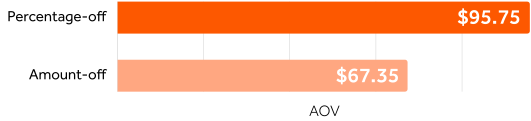
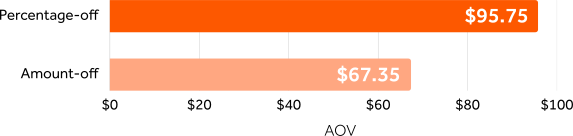
Customers spent 1.42x morewith percentage‑off discounts than amount‑off discounts

Horizontal bar chart comparing Average Order Value (AOV) between percentage-off and amount-off discounts. Percentage-off discounts generate an average order value of $95.75, while amount-off discounts generate an average order value of $67.35. Customers spend 1.42 times more when using percentage-off discounts. Percentage-off is shown in bright orange and amount-off in light orange.

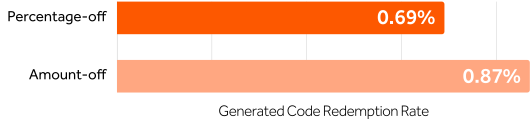
Customers redeemed amount‑off discounts 1.26x more than percentage-off discounts

Horizontal bar chart comparing generated code redemption rates between percentage-off and amount-off discounts. Amount-off discounts achieve a redemption rate of 0.87%, compared with 0.69% for percentage-off discounts. Customers redeem amount-off discounts 1.26 times more often than percentage-off discounts. Amount-off is shown in light orange and percentage-off in bright orange.

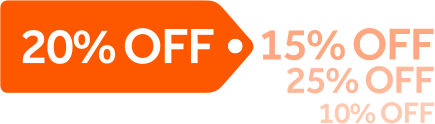
20% off was the sweet spotfor balancing AOV with redemptions

Visual ranking graphic comparing redemption and AOV performance across percentage-off discount levels. A large highlighted badge emphasizes 20% off as the strongest-performing discount level overall, balancing redemption rates and average order value more effectively than other common discount levels. Smaller labels for 15% off, 25% off, and 10% off appear alongside it, indicating lower overall performance. The chart's conclusion is that 20% off is the optimal percentage discount for balancing customer response with purchase value.

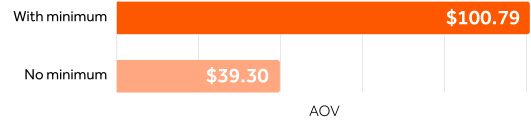
AOV was 2.6x higherwhen amount-off codes required a minimum spend

Horizontal bar chart comparing Average Order Value (AOV) for amount-off discounts with and without a minimum purchase requirement. Discounts with a minimum threshold generate an average order value of $100.79, while discounts with no minimum threshold generate an average order value of $39.30. Requiring a minimum purchase increases AOV by 2.6 times. The higher-performing option is shown in bright orange and the lower-performing option in light orange.

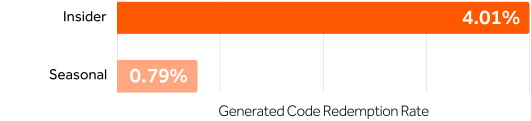
Customers redeemed “relationship-based” codes 5x morethan seasonal promotions

Horizontal bar chart comparing generated code redemption rates for relationship-based promotions versus seasonal promotions. Insider or relationship-based codes achieve a redemption rate of 4.01%, while seasonal promotions achieve a redemption rate of 0.79%. Relationship-based promotions are redeemed approximately five times more often than seasonal promotions. The insider category is shown in bright orange and seasonal promotions in light orange.

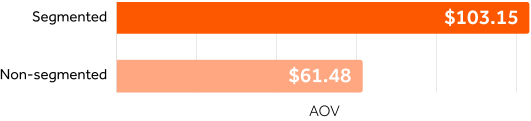
Segmented codes had 1.68x AOVcompared to discounts without customer eligibility restrictions

Horizontal bar chart comparing Average Order Value (AOV) for segmented discounts versus broad, non-segmented discounts. Segmented discounts generate an average order value of $103.15, while non-segmented discounts generate an average order value of $61.48. Segmented discounts produce 1.68 times higher AOV than discounts available to all customers. Segmented discounts are shown in bright orange and non-segmented discounts in light orange.

About the data

Our study focused on unique discount code sets generated with Seguno’s Bulk Discount Code Bot for use across marketing channels. App users tend to be more marketing-mature brands.

The dataset:

  • Covers 6,099 discount sets, representing a total of 182 million single-use, unique discount codes
  • Includes discounts created between January 1, 2025 and December 31, 2025
  • Stems from 1,348 brands (with Shopify Plus stores representing 74% of shops)
  • Spans 30 industries, as self-reported by brands (with 5% of brands’ industries not identifiable)
  • Skews North American-based brands (36%), followed by European (32%)

The research focuses strictly on two Shopify discount types — percentage and amount off — since they compose 97% of 2025 discount sets.

While we omitted buy X, get Y and free shipping discounts primarily because of low volume, their structure makes it difficult to directly compare them with value-based discounts.

This report does not include:

  • Analysis of the message promoting the discount
  • An estimate of incremental revenue lift, which would require a control group

Last year, our 2025 Discount Benchmark Report examined how Shopify brands use unique discount codes to grow.

Data definitions

The following data points appear throughout the 2026 Shopify Unique Discount Code Benchmark Report:

  • Discount sets: number of total sets created; sets consist of individual unique codes
  • Total codes used: number of redeemed unique discount codes (within discount sets)
  • Average order value (AOV): the mean dollar amount customers spent on an order when redeeming a code, based on total revenue generated divided by total codes used (we converted all revenue to USD)
  • Generated Code Redemption Rate (GCRR)*: codes used divided by codes generated. GCRR is not an exact usage rate, since brands sometimes create a large batch of codes and distribute them over time. Thus, we removed factors that would cause an inflated GCRR:
  • □    Included only one-use-per-customer codes
  • □    Analyzed sets that expired in 2025 to eliminate codes that are still valid

* We refer to GCRR as "redemption rate" in the narrative throughout this report; both terms refer to the same metric defined above.

About Bulk Discount Code Bot

Built for Shopify
Bulk Discount Code Bot App for Shopify

Use Bulk Discount Code Bot to power your unique discount strategy

Unique discount codes offer benefits that generic discount codes can’t: personalization, a safeguard against coupon abuse, and attribution.

With Seguno’s Bulk Discount Code Bot, generate unlimited unique coupon codes right in Shopify, then export them to any marketing channel.

  • Monitor performance by revenue, redemptions, and AOV for every set
  • Improve attribution reporting by tracking campaigns, channels, and departments
  • Sync and auto-replenish codes in Klaviyo for all Shopify discount types
  • Reduce support response times by looking up discount details from inside Gorgias
  • Catch weak safeguards before they cost you with a built-in discount risk audit
View Bulk Discount Code Bot App

What Shopify discount types do brands use most?

Brands chose percentage-off discounts more often than amount‑off discounts, at 1.2x the rate.

When analyzing all discount sets, percentage-off discounts accounted for 55% of the share.
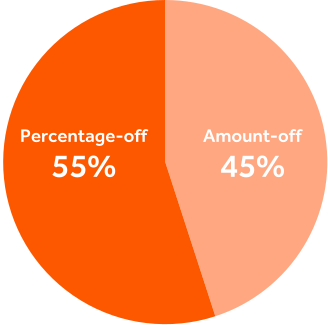
Pie-chart showing percentage-off discounts account for 55% of all discount sets vs amount-off discounts which only accounts for 45% of all discounts

Brands on the Shopify Plus plan used percentage off even more—60% of the time and 1.44x more often than amount-off codes.

All other brands not on Shopify Plus actually exhibited the opposite behavior, offering amount off 1.27x more than percentage off (56% of the time).

This split may reflect differences in price points and customer purchase behavior. Where percentage discounts retain their perceived value as the cart value rises, fixed-amount discounts can feel more immediately valuable on lower-priced purchases.
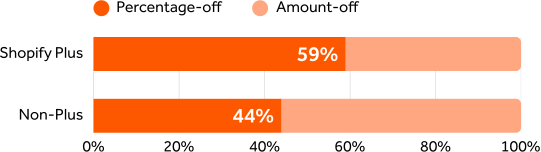
Shopify Plus brands offer percentage-off discounts 59% of the time vs Non Plus brands who offer percentage-off discounts only 44% of the time. Shopify Plus brands offer amount-off discounts 41% of the time, while non-plus brands offer it 56% of the time.

Which Shopify discount type correlates with the higher AOV?

Percentage-off discounts won in the cart value category, showing a 42% higher AOV.

The AOV for percentage-off codes was $95.75, a 1.42x lift over amount-off discounts ($67.35). The gap averaged $28 per order.

Percentage-off discounts have a higher AOV of $95.75 vs amount-off discounts whose Average Order Value is only $67.35

Which Shopify discount type do customers redeem more?

The amount-off discount had a modest but meaningful edge in redemption performance.

Percentage-off discounts correlated with substantially higher AOVs. But they were redeemed at a lower rate than amount-off discounts, according to our Generated Code Redemption Rate (GCRR) calculation.

Shoppers may find amount-off codes easier to evaluate than a percentage applied to a fluctuating cart total.

Generated Code Redemption Rate (GCRR) calculation   =   usages  /  total codes
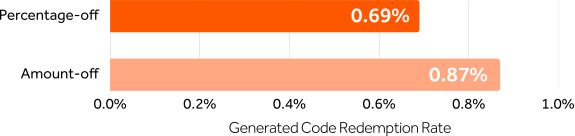
Percentage-off discounts are redeemed less frequently at 0.69% vs amount-off discounts which have a Generated Coupon Redemption Rate (GCRR) of 0.87%

How do Shopify discount types fare by industry?

Percentage off was the stronger discount across most industries.

We examined datasets for the eight industries (out of 30) that use unique discount codes most frequently, pitting the two discount types against each other on AOV and redemptions.

Results are mixed, but percentage off more often came out ahead, including:

Apparel is the only category where neither discount type showed a meaningful difference on either measure.

Where does percentage-off beat amount-off
IndustryAOV
Redemption
Apparel*
Beauty & FitnessX / NoCheckmark / Yes
Consumer ElectronicsCheckmark / YesX / No
Food & DrinkCheckmark / YesCheckmark / Yes
HealthCheckmark / YesCheckmark / Yes
Home & GardenCheckmark / YesX / No
SportsX / NoCheckmark / Yes
Toys & HobbiesCheckmark / YesCheckmark / Yes

*   no meaningful difference
†  Generated Code Redemption Rate

How big is the AOV gap between discount types by industry?

When percentage off wins on AOV, it tends to win big.

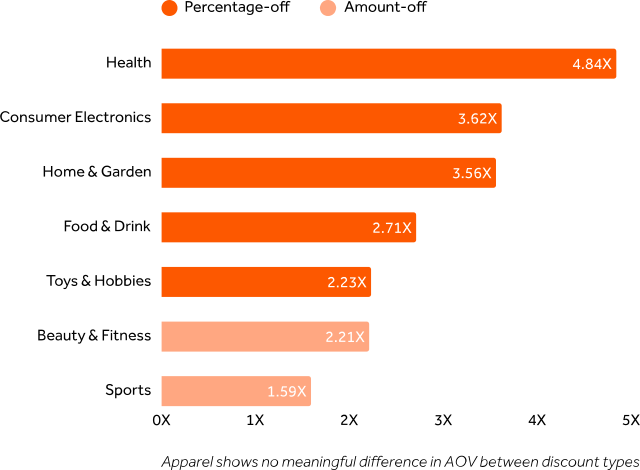
The health industry had the largest gap, with percentage-off AOVs nearly 5x higher than amount-off AOVs.

Percentage-off had a performance multiplier of 2.23x or more for:

  • Consumer electronics
  • Food & drink
  • Home & garden
  • Toys & hobbies

When amount off wins, the gaps are slimmer.

Beauty & fitness brands saw a 2.2x lift; sports brands saw 1.59x.

Horizontal bar chart comparing the Average Order Value (AOV) gap between percentage-off discounts and amount-off discounts across industries. The chart measures how many times higher the winning discount type’s AOV is versus the other type.

Industries ranked by AOV multiplier:

* Health: percentage-off discounts generate 4.84x higher AOV than amount-off discounts.
* Consumer Electronics: percentage-off wins by 3.62x.
* Home & Garden: percentage-off wins by 3.56x.
* Food & Drink: percentage-off wins by 2.71x.
* Toys & Hobbies: amount-off discounts generate 2.23x higher AOV than percentage-off discounts.
* Beauty & Fitness: percentage-off wins by 2.21x.
* Sports: amount-off wins by 1.59x.

Percentage-off categories are shown in bright orange, while amount-off categories are shown in light orange. The chart highlights that when percentage-off discounts outperform amount-off discounts, the difference is often substantial, especially in Health, Consumer Electronics, and Home & Garden. A note below the chart states that Apparel shows no meaningful difference in AOV between discount types.

How big is the redemption gap between discount types by industry?

Redemption rate differences by industry tell mostly a less decisive story than AOV.

The results are split:

  • Five industries saw higher redemption rates with percentage off:
    beauty & fitness, food & drink, health, sports, and toys & hobbies
  • Three industries saw higher redemption rates with amount off:
    apparel, consumer electronics*, and home & garden

Shoppers may find amount-off codes easier to evaluate than a percentage applied to a fluctuating cart total.

* Consumer electronics' multiplier is amplified by small base rates.
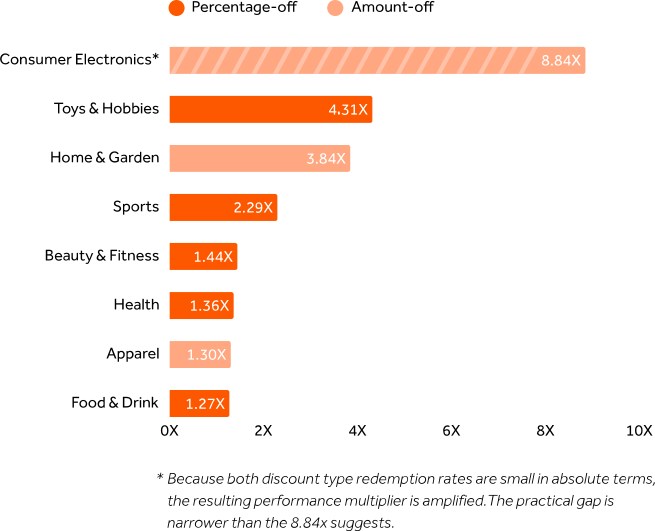
Horizontal bar chart comparing the redemption rate gap between percentage-off discounts and amount-off discounts across industries. The chart measures how many times higher the winning discount type’s redemption rate is versus the other type.

Industries ranked by redemption-rate multiplier:

* Consumer Electronics: amount-off discounts generate 8.84x higher redemption rates than percentage-off discounts. A footnote notes this large multiplier is amplified by very small baseline redemption rates, so the practical gap is narrower than it appears.
* Toys & Hobbies: amount-off wins by 4.31x.
* Home & Garden: percentage-off wins by 3.84x.
* Sports: percentage-off wins by 2.29x.
* Beauty & Fitness: amount-off wins by 1.44x.
* Health: percentage-off wins by 1.36x.
* Apparel: percentage-off wins by 1.30x.
* Food & Drink: percentage-off wins by 1.27x.

Percentage-off categories are shown in bright orange, while amount-off categories are shown in light orange. The chart emphasizes that redemption-rate differences are generally smaller and less decisive than AOV differences, with half of all industry gaps below 1.5x. Consumer Electronics is marked with an asterisk indicating the unusually large multiplier is driven by small absolute redemption rates for both discount types.

Industry reference table

Industry
Amount-off
Redemption
Code SetsTotal Codes UsedAOV
Apparel1.09%802334,626$106.62
Beauty & Fitness0.82%26048,555$198.57
Consumer Electronics0.38%1847,181$37.43
Food & Drink1.84%180107,030$26.08
Health1.06%848,686$14.75
Home & Garden2.60%1108,241$88.17
Sports0.21%45952$276.73
Toys & Hobbies0.62%5817,185$66.99
Percentage-off
Redemption
Code SetsTotal Codes UsedAOV
0.84%1,057415,294$97.22
1.18%70291,282$89.75
0.04%1525,857$135.41
2.33%355184,090$70.70
1.44%14877,798$71.36
0.68%48061,301$254.34
0.48%1125,248$174.41
2.68%7688,644$149.34

†  Generated Code Redemption Rate

What is the best percentage for a brand to offer?

20% won. It was also the most popular percentage-off choice among brands.

We zoomed in on the top five percentages offered. Among them, 20% correlated with the second-highest AOV ($108.10) and the highest redemption rate. Furthermore:

Percent offDiscount setsCodes usedAOV
Redemption
20%  OFF933225,941$108.100.89%
15%  OFF529208,446$92.850.80%
25%  OFF37374,328$106.110.88%
10%  OFF35738,250$122.680.20%
30%  OFF30237,632$103.770.56%

†  Generated Code Redemption Rate

How do discounts requiring a minimum spend fare?

Requiring a minimum spend was much more effective for amount-off codes, which correlate with a 2.6x lift in AOV.

Minimums on an amount-off code show:

  • A substantial AOV boost of 2.6x compared to codes with no minimum ($100.79 for a spend requirement vs $39.30)
  • A modest dip in redemption rate
    (0.76% for a spend requirement vs 1.00%)
Amount-off
Redemption
Discount setsCodes usedAOV
With minimum0.76%860282,415$100.79
No minimum1.00%1,765329,466$39.30

Minimums on a percentage-off code show:

  • A slight lift in AOV of 1.16x versus requiring no minimum spend ($110.08 for a spend requirement vs $94.47)
  • A 63% drop in redemption rate
    (0.27% for a spend requirement vs 0.73%)
Percentage-off
Redemption
Discount setsCodes usedAOV
With minimum0.27%24222,808$110.08
No minimum0.73%3,064745,715$94.47

†  Generated Code Redemption Rate

Brands and shoppers have reasons for gravitating to amount-off discounts that require minimum thresholds.

How do Shopify discount types fare by use case?

While seasonal discounts dominated in volume, “insider” (relationship-based) codes led in AOV and redemption.

Use caseDescriptionDiscount setsAOV
Redemption
Seasonal DiscountsSeasonal or monthly promotions2,270$92.710.79%
InsiderPerks for employees/friends/students776$143.674.01%
HolidayCampaigns tied to major holidays, shopping events (i.e., BFCM), cultural celebrations, and birthdays/anniversaries594$73.630.75%
Marketing lifecycleCustomer journey touchpoints, such as prospecting, email subscriptions, abandonment, post‑purchase, and winback  529$92.511.01%
AffiliateDiscounts shared by partners or influencers 476$137.082.38%
LoyaltyPromos for loyalty program members or customers who provide reviews387$120.261.67%

†  Generated Code Redemption Rate

Viewing use cases through the AOV-redemption lens, the discounts stacked up relatively even, with percentage-off holding a slight edge.

Otherwise:

Where does percentage-off beat amount-off
Use caseAOV
Redemption
AffiliateX / NoCheckmark / Yes
InsiderX / NoX / No
HolidayCheckmark / YesX / No
LoyaltyCheckmark / YesCheckmark / Yes
Marketing LifecycleCheckmark / YesCheckmark / Yes
Seasonal Discounts*

*   no meaningful difference
†  Generated Code Redemption Rate

How big is the AOV gap between discount types by use case?

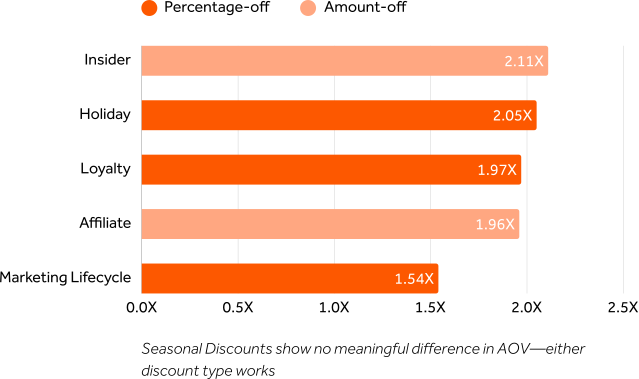
Across nearly every use case, the AOV difference between discount types was about 2x.

When percentage-off wins:

  • Holiday (2.05x)
  • Loyalty (1.97x)
  • Marketing lifecycle (1.54x)

When amount-off wins, the magnitudes are comparable:

  • Insider (2.11x)
  • Affiliate (1.96x)

Seasonal discounts show no meaningful difference between the two, meaning either type works for these broad campaigns.

Horizontal bar chart comparing the Average Order Value (AOV) gap between percentage-off discounts and amount-off discounts across marketing use cases. The chart measures how many times higher the winning discount type’s AOV is versus the other type.

Use cases ranked by AOV multiplier:

* Insider campaigns: amount-off discounts generate 2.11x higher AOV than percentage-off discounts.
* Holiday campaigns: percentage-off discounts generate 2.05x higher AOV than amount-off discounts.
* Loyalty campaigns: percentage-off wins by 1.97x.
* Affiliate campaigns: amount-off wins by 1.96x.
* Marketing lifecycle campaigns: percentage-off wins by 1.54x.

Percentage-off categories are shown in bright orange, while amount-off categories are shown in light orange. The chart shows that AOV differences between discount types cluster around 2x across most use cases, regardless of which discount type performs better. A note below the chart states that seasonal discounts show no meaningful difference in AOV between percentage-off and amount-off discounts, suggesting either approach works similarly well for broad seasonal campaigns.

How big is the redemption gap between discount types by use case?

The winning discount type varies by use case—and the gaps can surpass 3x.

Two use cases set the high bar for redemption rate gaps, and they sit on opposite sides:

  • Affiliate: percentage off shows a 3.27x lift over amount off
  • Holiday: amount off shows a 3.98x lift over percentage off
    (though important to note, small base rates amplify the multiplier)

Beyond those, percentage off had the edge in loyalty (2.4x) and marketing lifecycle (1.58x), while amount off had the edge in insider (1.59x).

Seasonal discounts show no meaningful difference; either type works.
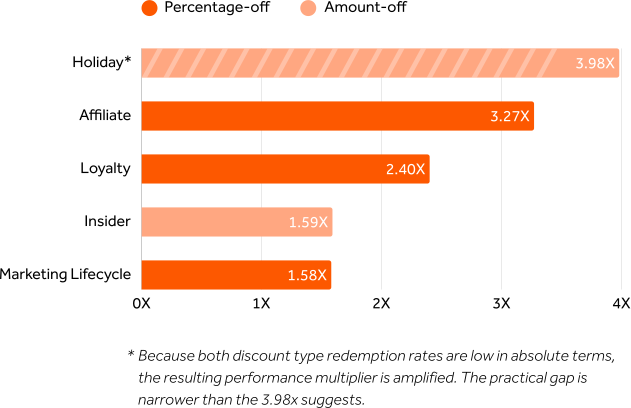
Horizontal bar chart comparing the redemption rate gap between percentage-off discounts and amount-off discounts across marketing use cases. The chart measures how many times higher the winning discount type’s redemption rate is versus the other type.

Use cases ranked by redemption-rate multiplier:

* Holiday campaigns: amount-off discounts generate 3.98x higher redemption rates than percentage-off discounts. A footnote notes this large multiplier is amplified by very small baseline redemption rates, so the practical gap is narrower than it appears.
* Affiliate campaigns: percentage-off discounts generate 3.27x higher redemption rates than amount-off discounts.
* Loyalty campaigns: percentage-off wins by 2.40x.
* Insider campaigns: amount-off wins by 1.59x.
* Marketing lifecycle campaigns: percentage-off wins by 1.58x.

Percentage-off categories are shown in bright orange, while amount-off categories are shown in light orange. The chart highlights that the largest redemption-rate gaps occur in opposite directions depending on the use case: affiliate campaigns strongly favor percentage-off discounts, while holiday campaigns strongly favor amount-off discounts. Smaller advantages appear for loyalty and marketing lifecycle campaigns in favor of percentage-off discounts, and for insider campaigns in favor of amount-off discounts. A note below the chart states that seasonal discounts show no meaningful difference between discount types, suggesting either approach performs similarly.

Use case reference table

Marketing Use Case
Amount-off
Redemption
Code SetsTotal Codes UsedAOV
Affiliate1.06%18816,250$226.18
Insider6.20%21512,537$278.27
Holiday1.30%326136,980$58.48
Loyalty0.91%14325,923$68.43
Marketing Lifecycle0.69%12525,849$63.20
Seasonal Discounts0.74%916263,473$89.24
Percentage-off
Redemption
Code SetsTotal Codes UsedAOV
3.46%28865,892$115.11
3.89%561139,864$131.60
0.33%26844,671$120.08
2.19%24491,187$134.99
1.09%404161,045$97.22
0.81%1,354472,331$94.65

†  Generated Code Redemption Rate

What happens when you limit discount usage to a segment?

Segmented discounts tend to correlate with more valuable purchases.

And that’s true for both discount types, demonstrating an AOV lift of:

The tradeoff? Customers redeemed restricted codes — that limit eligibility to specific customers — slightly less than broad, non-segmented discounts.
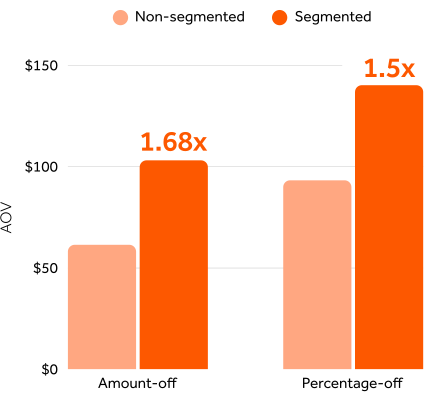
Grouped vertical bar chart comparing Average Order Value (AOV) for segmented versus non-segmented discounts across two discount types: amount-off and percentage-off.

The chart shows that segmented discounts consistently produce higher AOVs than non-segmented discounts for both discount types.

For amount-off discounts:

* Non-segmented discounts generate an AOV of approximately $60.
* Segmented discounts generate an AOV of approximately $101.
* This represents a 1.68x increase in AOV for segmented offers.

For percentage-off discounts:

* Non-segmented discounts generate an AOV of approximately $93.
* Segmented discounts generate an AOV of approximately $140.
* This represents a 1.5x increase in AOV for segmented offers.

Non-segmented bars are shown in light orange, while segmented bars are shown in bright orange. The chart supports the conclusion that broad, non-segmented discounts are redeemed slightly more often, but targeted segmented discounts correlate with larger purchase values. It also emphasizes that segmented offers paired with personalized messaging tend to drive higher-value purchases regardless of discount type.

Segmented codes are a small slice of the dataset, accounting for just 4%.

Almost all unique discount sets (95.8%) were non-segmented, meaning they could be used by anyone.

Segmented offers typically pair with targeted messaging, which resonates with shoppers who want relevant, personalized offers.
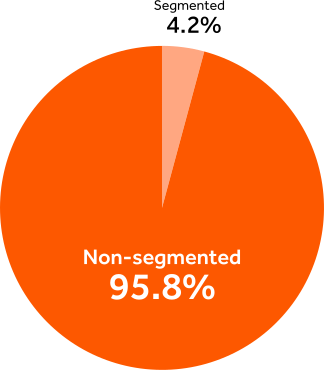
Pie-chart showing almost all unique discount sets (95.8%) are non-segmented, while the remaining 4.2% of unique discounts use some form of segmentation.

Segmentation reference table

Discount Type
Segmented
Redemption
Code SetsTotal Codes UsedAOV
Amount off0.75%15086,873$103.15
Percentage off0.78%10440,372$140.24
Non-segmented
Redemption
Code SetsTotal Codes UsedAOV
0.90%2,595529,879$61.48
0.68%3,250731,305$93.30

†  Generated Code Redemption Rate

6 smart ways to use unique discount codes

Based on the 2026 Shopify Unique Discount Code Benchmark Report data, here are six practical ways to get better performance out of your unique discount codes:

Lean into percentage off if your focus is AOV.The data shows that percentage-off discounts correlated with higher spending in most use cases and industries.

Choose amount off if your focus is on redemptions.Customers redeemed amount-off discounts 1.26x more often than percentage‑off discounts.

Stick with 20% off as your workhorse percentage.It was the most popular choice for a reason: it balances strong AOV with a strong redemption rate.

Implement thresholds to maximize performance.For amount-off discounts, boost AOV by requiring a minimum spend. For percentage-off discounts, prevent outsized savings on large orders by capping the maximum discount amount or restricting product eligibility.

Don't sleep on relationship-based use cases.Insider use cases delivered above-average AOV and redemption rates, far surpassing broad, seasonal campaign performance.

Target your offers more often by limiting them to particular segments.Codes restricted to a specific customer segment demonstrated a lift in AOV with no meaningful trade-off on redemption rate.

Built for Shopify
Bulk Discount Code Bot App for Shopify

Use Bulk Discount Code Bot to power your unique discount strategy

Unique discount codes offer benefits that generic discount codes can’t: personalization, a safeguard against coupon abuse, and attribution.

With Seguno’s Bulk Discount Code Bot, generate unlimited unique coupon codes right in Shopify, then export them to any marketing channel.

View Bulk Discount Code Bot App